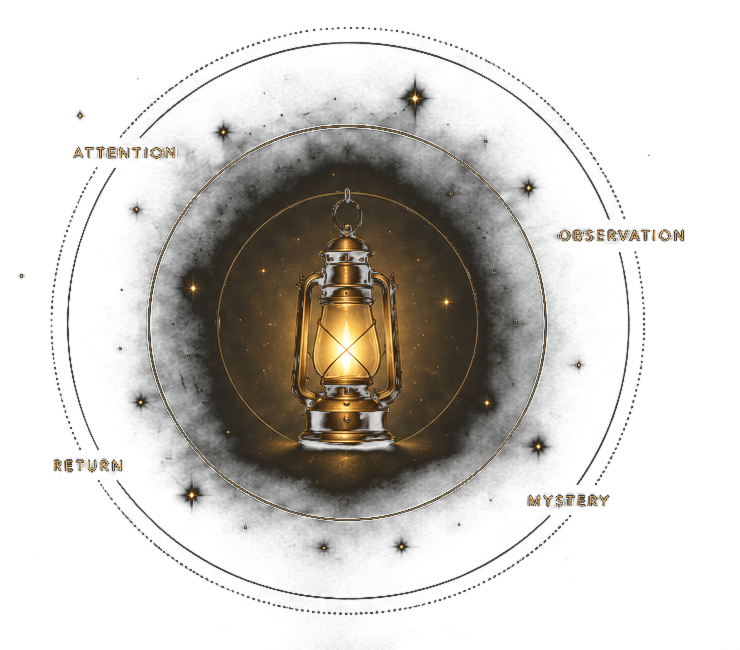
Reality is our first teacher.
Symbols, practices, and ideas must remain answerable to lived experience.
Humanity has spent centuries learning to map the outer world. The Lantern begins with a quieter proposition: the interior world deserves the same quality of attention.
We have learned to name galaxies, measure mountains, chart oceans, and study the smallest structures of matter. The Lantern turns that same spirit of careful attention toward another terrain: the place where love, grief, identity, memory, meaning, beauty, and choice become lived experience.
Not because the inner world is more important than the outer one. Because it also deserves to be explored with care.
We are cartographers.
Not owners.
Not authorities.
Travelers.
The Lantern does not ask a reader to surrender science, philosophy, religion, skepticism, or personal experience at the door. Its maps are invitations to notice.
Where a map fails to describe the territory, the map must change. Reality remains the first teacher and the final editor.
These are not doctrines a reader is asked to adopt. They are disciplines the work asks of itself.
Symbols, practices, and ideas must remain answerable to lived experience.
Whenever possible, recognition arrives through experience before explanation.
Mystery is not a defect to eliminate. Some truths remain alive because they are not exhausted.
The work accompanies. It does not preach downward or demand agreement.
If the books succeed, attention eventually returns to rain, rooms, meals, people, work, silence, and ordinary life.
“Can I tell you something I’ve noticed?”
Long before there were books, there were conversations: beside fires, at kitchen tables, on fishing boats, on park benches, in rooms where one person trusted another enough to speak honestly.
One person noticed something. Another listened. Sometimes they saw the same thing. Sometimes they did not. Either way, the world could be looked at again.
The Lantern belongs to that lineage of shared noticing. Every honest observation can become another light along the trail.
The books stand on their own. Other parts of the wider work offer different ways to continue, but none is a condition of belonging here.
The books, Mountains, Places, symbols, stories, and reader experiences gathered around the inner landscape.
The publishing imprint behind The Lantern and the home of its editions and related literary work.
Guided practice, coaching, and community work that may carry ideas from the page back into lived experience.
Software for intentional reflection, mapping, and journaling. A tool for travelers, not the territory itself.
The wider body of work within which these projects are being developed and related.
The Lantern is written by Christopher Jerome MacIsaac and published under Inner Order Press.
The aim is not to build a system that replaces the reader’s own understanding. It is to make careful maps, offer them honestly, and leave enough blank space for another Traveler to discover what the map could never contain.
Start with an opening passage. Enter a Mountain. Carry what helps. Leave what does not. Keep looking.
“Can I tell you something I’ve noticed?”
Sometimes that is enough to begin.